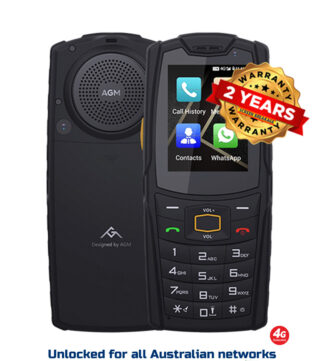
A cracked screen after one drop from the ute is annoying. Losing contact with the crew because your mobile cannot hold signal, has a flat battery or will not accept the work SIM is a bigger problem. Choosing a dual SIM rugged phone in Australia is not about getting the biggest battery or the loudest specification sheet. It is about buying a device that works on Australian networks, survives the conditions and gives you a practical way to separate work from life.
For farmers covering big properties, tradies moving between sites, transport operators, miners and remote workers, two active SIM slots can be genuinely useful. But dual SIM only adds value when the phone itself is properly built, correctly configured and backed by someone who understands hard-use devices.
Why dual SIM matters on the job
A dual SIM phone lets you run two mobile services from one handset. The obvious setup is one number for work and one for personal calls, so you do not have to carry a second phone in your pocket or leave it rattling around the cab. It also means you can keep a long-standing personal number while using an employer-provided service for work.
The more practical advantage can be coverage. No one carrier is strongest everywhere. A worker travelling between regional depots, remote properties and metro jobs may get a usable signal from one network where another drops out. Two SIMs give you options, provided the services use networks that suit the areas you actually work in.
There are limits. A dual SIM handset does not magically combine two weak services into one strong connection. Most phones are dual-SIM dual-standby, meaning both numbers can receive calls while idle, but the phone generally uses one SIM at a time for mobile data. If a call arrives on one line, the other may be temporarily unavailable depending on the network and handset design. That is normal behaviour, not a fault.
Check Australian network support before anything else
The 3G shutdown changed the buying rules. A cheap imported handset may appear to work at first, then prove unreliable for calls, emergency calling or regional coverage because its 4G calling support is incomplete. Never assume that a phone advertised as “global” is properly suited to Australia.
A worthwhile dual SIM rugged phone should support the Australian 4G and 5G frequency bands used by your chosen carrier, along with VoLTE support. VoLTE matters because voice calls now rely on 4G in many situations. If you work away from town, check the carrier coverage map for the specific places you travel, not just your home address.
Also ask how the phone handles the two SIMs. Some models use two physical nano-SIM slots. Others use one SIM slot and a shared second slot that can take either another SIM or a microSD card. If you need extra storage for site photos, offline maps, inspection records or video, a dedicated microSD slot is worth having.
5G is useful where it is available, particularly for transferring large files or using the phone as a hotspot. It is not the first buying priority for every worker. Strong 4G coverage, good antennas and dependable VoLTE are often more useful than a 5G logo when you are kilometres from the nearest major town.
Do not confuse a thick case with a rugged phone
A consumer phone in a bulky case is still a consumer phone. It may survive a minor knock, but it was not designed for vibration in machinery, dirty hands, rain, concrete dust or repeated drops. A proper rugged mobile starts with the chassis, screen protection, port seals, button design and internal construction.
Look for clear ingress and drop ratings, but read them sensibly. IP68 and IP69K ratings indicate resistance to dust and water under stated test conditions. They do not mean you should leave the phone underwater, charge it wet or assume saltwater, high-pressure damage and neglect will be covered. Clean mud and grit from the charging port, dry the handset before charging and inspect seals after a hard impact.
Drop ratings are equally useful only when they are supported by decent construction. A phone with a raised screen edge, reinforced corners and a frame designed to absorb impact has a better chance of surviving a fall than a slim handset wearing a marketing-grade case. Weight is the trade-off. A serious rugged phone is usually thicker and heavier than a mainstream mobile. For most field users, that is a fair exchange for a device that is still working at knock-off.
Factory quality matters as well. Not every rugged-looking phone is built to the same standard, even when the advertised specifications look similar. Poorly fitted seals, weak charging ports, inferior batteries and glued-shut designs can turn a cheap buy into a disposable nuisance. This is why specialist selection and meaningful warranty support matter more than chasing the lowest online price.
Battery capacity is only part of the story
Large batteries are a major reason people choose rugged phones. A 10,000 mAh or larger battery can be a serious advantage during long shifts, overnight travel, remote work or days where a power point is nowhere near the job. It can also make hotspot use, navigation and constant messaging more realistic.
Still, capacity figures alone do not tell you how long the phone will last. Screen brightness, 5G use, weak reception, thermal cameras, night vision, GPS tracking and hotspot use all draw power. A phone hunting for signal in marginal coverage can drain faster than expected, whatever the battery size says on the box.
Consider your charging routine. USB-C fast charging can get a phone back in service quickly, while reverse charging may let you top up a small accessory in a pinch. For remote work, carry a quality vehicle charger or power bank anyway. The best battery is not a reason to stop planning for a long day.
Match the features to the work, not the hype
The right device depends on what happens during your shift. Construction and transport users may prioritise a bright display, glove-friendly operation, a loud speaker and a dependable camera for proof-of-delivery or site documentation. Farmers and outdoor crews may value battery life, strong GPS performance and a programmable button that can launch a torch, push-to-talk app or emergency contact.
For inspection work, night vision or thermal imaging can be more than a novelty. These tools can help identify hot electrical components, heat loss, animal movement or equipment issues where ordinary cameras are limited. They cost more and suit particular jobs, so do not pay for them if a standard camera and torch will do.
Parents, schools and organisations with limited-use requirements have a different brief. A rugged feature phone or restricted smartphone may be the smarter choice where long battery life, calls and texts matter more than social media. More features are not automatically better. The best phone is the one that does the required job without adding unnecessary distractions or failure points.
Set up both SIMs properly
Once you have the handset, label the SIMs in the phone settings as Work and Personal, or by carrier name. Set a preferred SIM for calls, texts and mobile data. If you receive many work calls, choose whether the phone should ask which line to use each time or default to the work number.
Test both services before relying on the phone in the field. Make calls, send texts, switch mobile data between SIMs and check voicemail. If you use a work app, two-factor authentication or a fleet-management platform, confirm that it recognises the right number. Small setup jobs done at the kitchen bench are far better than discovering a problem at a remote gate or on a night shift.
It is also worth fitting a screen protector and case if the model supports them. Rugged does not mean invincible. Accessories are cheap insurance against the wear that comes from keys, tools, grit and daily use.
Buy for the conditions you actually face
Rugged Phones Australia focuses on devices that earn their place through practical build quality, usable features and support that does not disappear after checkout. That approach matters when your phone is a work tool rather than another disposable gadget.
Start with where you work, which carrier services you need, whether you need two physical SIMs and how long you must go between charges. Then choose the toughest phone that meets those needs without paying for gimmicks you will never use. A properly selected dual SIM rugged phone should make your working day simpler, not give you another piece of gear to worry about.