At 4.30 am on a mine access road, a standard mobile camera and torch are close to useless. You need to know whether there is a person, roo, vehicle or overheating component ahead – and you need an answer before you walk into the dark. Thermal camera versus night vision is not a spec-sheet contest. They solve different problems, and buying the wrong one can leave a useful-looking feature sitting idle when conditions turn nasty.
For workers in farming, transport, construction, security and remote operations, the right choice comes down to one question: do you need to detect heat, or do you need to see the scene clearly in the dark?
Thermal camera versus night vision: the real difference
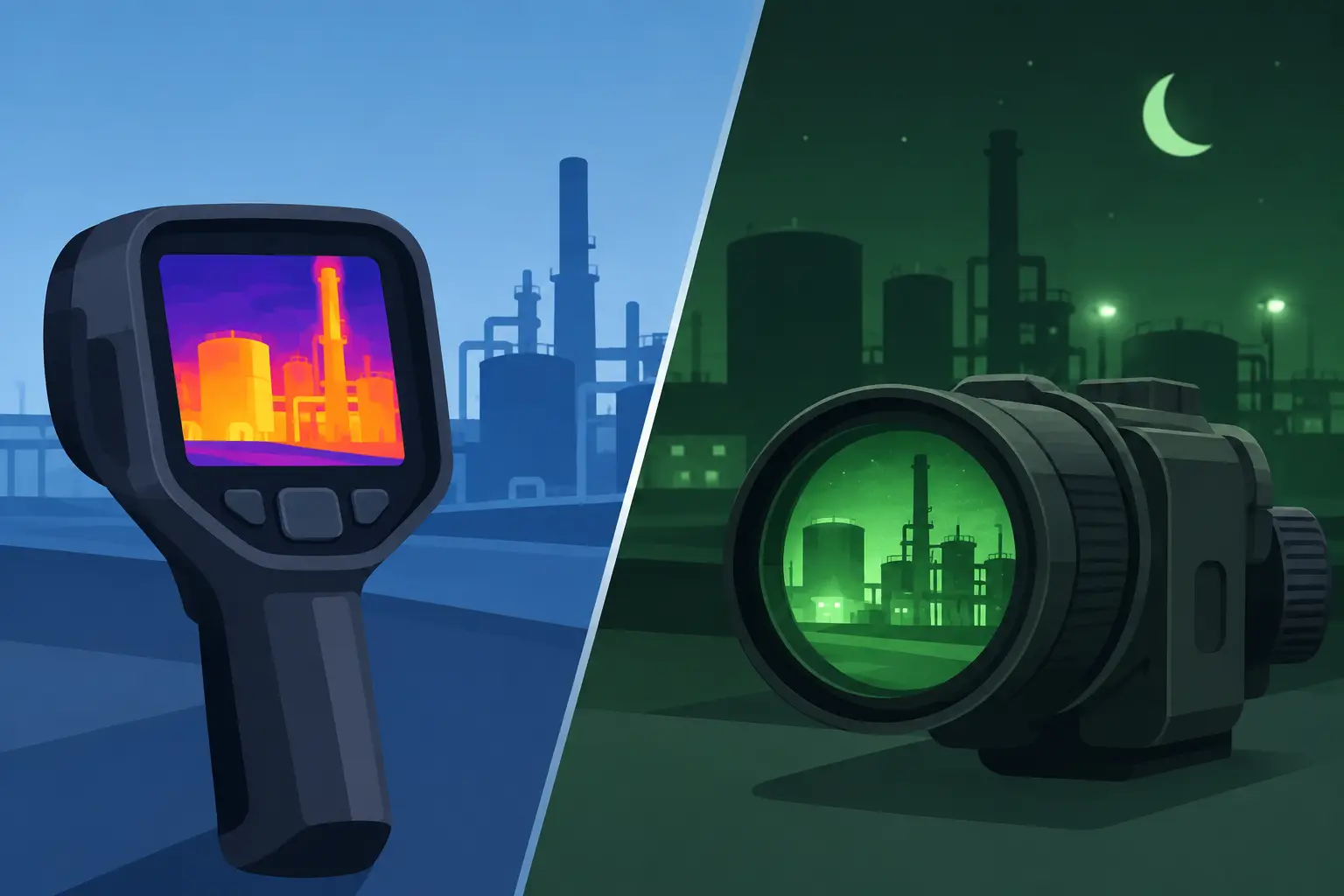
A thermal camera detects heat energy emitted by objects. It does not need visible light, moonlight or an infrared torch. A running engine, a warm electrical connection, livestock, a person and a recently used machine component can stand out because their temperature differs from the surrounding environment.
Night vision on a rugged mobile usually works differently. It uses an infrared-sensitive camera and infrared LEDs to illuminate the area with light that is largely invisible to the human eye. The camera then displays a black-and-white image of reflected infrared light. Think of it as a torch your eyes cannot see, rather than a heat map.
That distinction matters. Thermal tells you where temperature contrast exists. Night vision gives you a more familiar image, with edges, objects and often enough detail to identify what you are looking at. Neither is automatically better. A worker checking a hot bearing has a different requirement from a property owner trying to read a vehicle number plate after dark.
What a thermal camera does well
Thermal imaging earns its place when heat is the clue. In total darkness, a thermal camera can reveal people, animals or vehicles against cooler ground. On a station, it can help spot livestock near a fence line before a vehicle reaches them. Around plant and equipment, it can flag an unusually hot motor housing, belt, battery terminal or electrical connection that deserves a closer inspection.
It is also useful where visual clutter makes ordinary cameras frustrating. Camouflage, shaded scrub and dark clothing do not hide an object that is warmer or cooler than its background. Light smoke can be less of a problem than it is for visible-light cameras, though no thermal camera should be treated as a guarantee of vision through fire conditions.
A thermal image is not the same thing as a detailed photograph. A person may appear as a clear warm silhouette, but facial features, labels, wire colours and vehicle plates will not be obvious. The image depends heavily on the temperature difference between the target and its surroundings. A warm person in a cold paddock is easy to find. A warm machine in a hot, sun-baked yard may offer much less contrast.
Thermal has hard limits
Ignore the marketing rubbish that implies thermal can see through anything. It cannot see through walls, and standard window glass usually blocks long-wave infrared energy. Point a thermal camera at a closed vehicle window and you may mostly see a reflection or the temperature of the glass, not the person inside.
Heavy rain, dense fog, dust and humidity can also reduce performance. Thermal often remains useful in poor light, but it is not magic vision. Distance, sensor resolution, lens quality and the size of the target all matter. A low-resolution thermal sensor may be enough to find an animal or a heat issue nearby, yet insufficient to tell exactly what you have found at longer range.
Temperature readings need context
Many thermal-equipped mobiles display temperature measurements, which can be genuinely useful for comparative checks. If one terminal is much hotter than matching terminals, or one bearing is hotter than the same bearing on another machine, you have a reason to investigate.
Do not mistake that reading for a laboratory-grade diagnosis. Surface finish, distance, angle, reflections and emissivity affect accuracy. Shiny metal is particularly troublesome. Use thermal imaging to identify abnormal patterns, follow site procedures, and confirm critical findings with the right test equipment and qualified people.
Where night vision is the smarter tool
Night vision is the better choice when recognising the scene matters more than detecting a heat difference. It can show gates, tracks, tools, trailers, fence wires, buildings and people in a familiar monochrome image. For walking around a worksite, checking a shed, locating gear in a ute tray or monitoring an entry point, that practical detail can matter more than a coloured heat palette.
Because night vision relies on infrared illumination, its useful range depends on the strength and placement of the LEDs, the camera sensor and how reflective the surroundings are. Pale surfaces may appear strongly lit, while dark timber or open ground absorbs more light. High-vis clothing, reflective signs and number plates can flare brightly, which is helpful in some situations and annoying in others.
Night vision also has a key advantage around glass. An infrared camera can generally see through a clean window in the same broad way a normal camera can, provided reflections are controlled. That makes it more practical for checking outside from a vehicle or building. Put the mobile close to the glass, reduce cabin lights and avoid aiming directly at reflective surfaces.
Its weakness is obvious once you think about it: without usable infrared illumination, there is no image. It does not identify a hot fault, and it will not make an animal stand out from dark bush simply because the animal is warm. Fog, rain and dust can scatter infrared light back towards the camera, creating glare and reducing the usable view.
Choose the tool for the task, not the headline feature
A thermal mobile makes sense for maintenance teams, farmers checking stock or predator activity, security workers scanning large dark areas, and anyone who needs to find a heat source quickly. It is especially valuable when you need an early warning that something is present, hot or unusual.
A night-vision mobile suits workers who need to navigate, inspect or document a dark scene. It is the more natural fit for checking equipment layouts, identifying objects, taking usable black-and-white footage and seeing where you are stepping. A good ordinary LED torch is still worth having, but night vision lets you observe without broadcasting visible light across the site.
If your job crosses both needs, a rugged mobile with thermal and night vision can be justified. That is not feature collecting when each camera has a defined job. It is a practical way to carry two specialised inspection tools without adding another device to the cab, tool bag or site kit.
Before paying extra, be honest about these four questions:
- Do you need to find people, animals or heat faults in complete darkness?
- Do you need to identify objects, read markings or document a scene after dark?
- Will you be working through vehicle windows, in rain, dust or humid conditions?
- Is the camera a convenience feature, or will it support safety checks and regular inspection work?
The answers will usually point clearly to thermal, night vision or both.
Do not overlook the mobile around the camera
A specialised camera is only useful if the mobile itself survives the environment. For field work, look beyond the headline sensor. Battery capacity, glove-friendly controls, screen brightness, waterproofing, charging reliability, network compatibility and a case design that can take knocks all affect whether the device remains useful six months later.
Also check how the thermal app stores images and video, whether temperature points can be added to an image, and how easily files can be shared for reports. A camera that helps you spot an issue but makes documentation painful is only doing half the job. Rugged Mobiles Australia focuses on vetted hard-use devices because the camera specification is not much help when the mobile has poor support, weak sealing or a battery that gives up halfway through a shift.
Buy thermal imaging when heat is the information you need. Buy night vision when clear dark-scene detail is the priority. Get both only when your work genuinely calls for both – then learn their limits before the night you need them most.