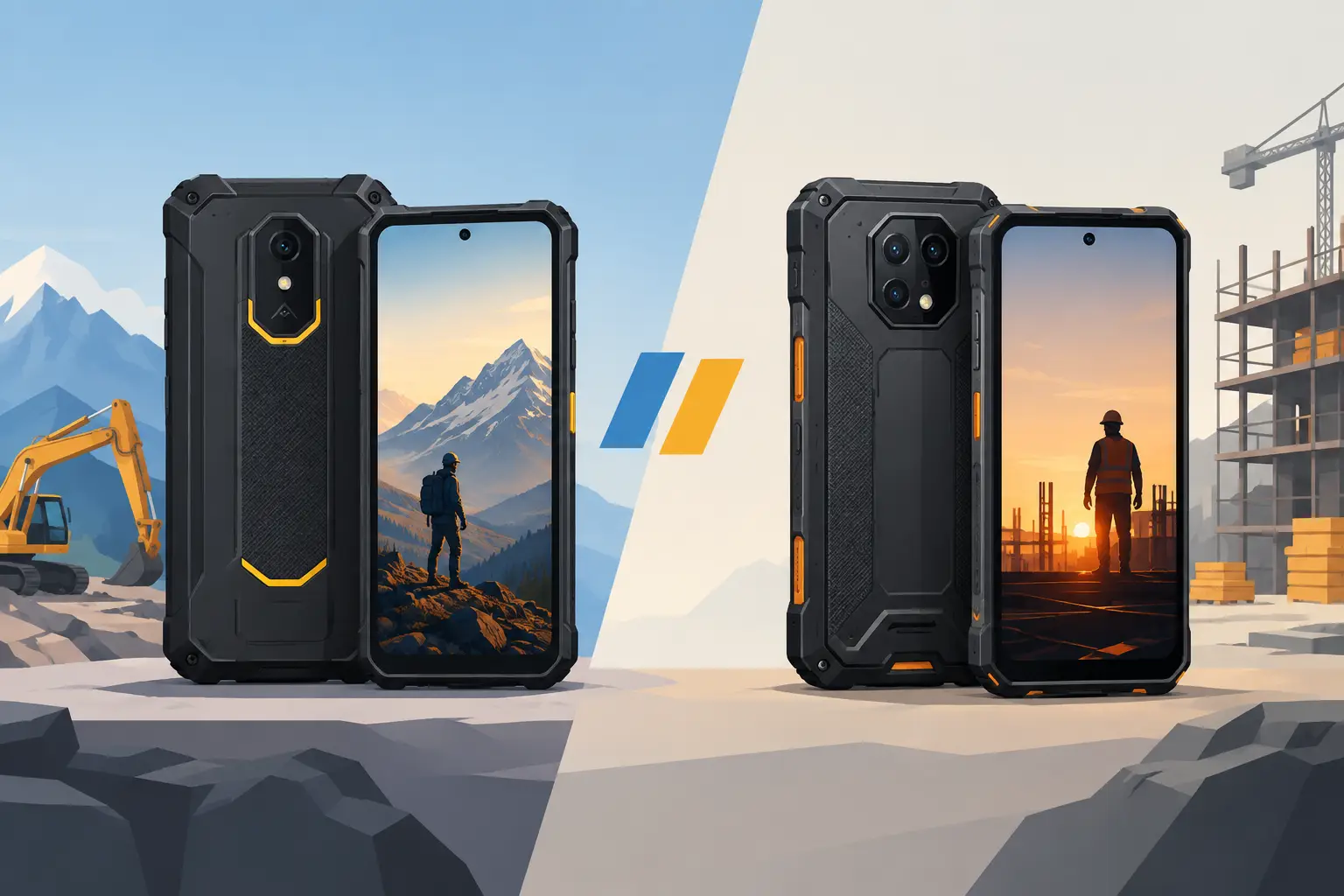
A cracked screen at the end of a shift is annoying. A dead mobile halfway down a property, on a mine haul road or between jobs is a genuine operational problem. AGM versus Ulefone phones is not a contest decided by which brand has the biggest battery figure or the loudest waterproof claim. It comes down to the specific model, how it is built, and whether its features solve a real problem in your work.
Both brands make Android phones designed to take more punishment than an ordinary consumer handset. Both offer serious battery life, water and dust protection, reinforced housings and useful specialist options. But their ranges have different priorities. Choose based on the job in front of you, not a spec sheet that looks impressive from across the room.
AGM versus Ulefone phones: the practical difference
AGM tends to appeal to buyers who want a rugged mobile without unnecessary bulk, plus a few very targeted devices for restricted-use or specialist applications. Ulefone has a broader Armour range and often pushes hard on big screens, huge batteries, camera hardware and worksite tools such as thermal imaging or night vision.
That does not make one brand automatically better. A truck driver who needs navigation, messaging, a bright large display and two-day battery life may get more from a Ulefone. A parent, school or employer looking for a tightly controlled phone with no internet or social media access may find AGM’s purpose-built options far more sensible. A farmer who needs to identify a hot bearing or inspect stock after dark should look at the actual thermal or night-vision model available, rather than buying a standard rugged phone and hoping the camera will do a specialist job.
The first rule is simple: do not compare brand against brand in the abstract. Compare model against task.
Build quality is more than an IP rating
AGM and Ulefone commonly use the rugged-phone basics: sealed ports or covered connectors, raised screen bezels, reinforced corners and housings designed for dust, rain and accidental drops. Many models carry IP68 or IP69K ratings and military-style drop-test claims. Those ratings matter, but they are not a licence to abuse any phone indefinitely.
Water resistance is tested under defined conditions, not after months of grit in the charging port, a damaged seal or repeated impacts on concrete. A phone that survives a clean laboratory dunk may still fail if its USB-C port is packed with metal filings or its screen protector is lifting at the edge. For workshops, farms and construction sites, a quality case, screen protection and sensible charging habits remain worthwhile.
Ulefone often produces physically larger handsets because it packs in bigger batteries, larger displays and additional sensors. That can be exactly right for workers wearing gloves, reading maps in a ute or filling out forms on site. The trade-off is obvious after a week in the pocket: size and weight. A massive battery is excellent when you are away from a charger, but it is less appealing if you spend all day climbing ladders or carrying the phone in a shirt pocket.
AGM models can be a better fit where portability, simpler operation or controlled functionality matters more than having every possible sensor. Rugged does not have to mean brick-sized.
Battery capacity needs context
A large battery is one of the main reasons people move to a rugged phone. Ulefone is particularly well known for models with enormous battery capacities, and these can be outstanding for long shifts, remote travel and jobs where charging access is limited. For field crews working away from mains power, the reduction in daily charging can be a major advantage.
But capacity is not the only battery question. A larger, brighter display, 5G use, GPS tracking, thermal cameras, high screen refresh rates and poor reception all consume power quickly. If your work takes you through fringe coverage, the mobile may work harder searching for a signal than it does running your usual apps.
Also consider charging speed and charging routine. A very large battery can take a long time to replenish if the charger, cable or vehicle outlet is inadequate. If you regularly charge in a vehicle, at a depot or from a power bank, check that the charging arrangement suits the model. Fast charging is handy, but good battery management and a dependable cable are what get you through the week.
For straightforward calls, texts, photos and navigation, many AGM models have more than enough endurance without the weight penalty of the largest battery phones. For multi-day fieldwork, remote surveying or extended camping, Ulefone’s high-capacity models often make stronger practical sense.
Cameras and specialist sensors
Standard camera megapixel numbers are an easy place for manufacturers to create noise. For work, the useful questions are less glamorous: Can it focus on a serial number? Can you take a clear photo in a dim plant room? Can you document damage in rain? Can the image be sent reliably from site?
Ulefone’s range generally gives buyers more choice in specialist imaging. Selected models include genuine thermal imaging modules, night vision cameras, endoscopes or other inspection-oriented functions. These are not gimmicks when the work calls for them. Thermal imaging can help identify heat anomalies in electrical equipment, mechanical components and building inspections. Night vision can be useful around properties, yards and equipment after dark.
There is a catch. Specialist cameras add cost, size and complexity. A thermal phone is worth paying for if you will use it regularly and understand its limits. It is not a replacement for a calibrated professional instrument where compliance, precise temperature measurement or formal reporting is required. Nor should night vision be confused with a high-quality everyday camera.
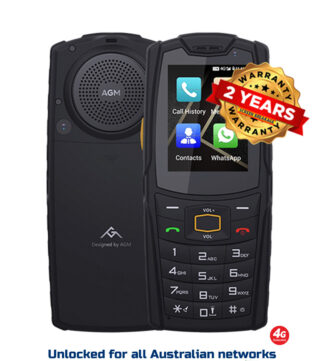
AGM also has specialist devices in selected parts of its line-up, but it is often the stronger choice when your requirement is controlled communication rather than an all-in-one inspection tool. For example, a no-internet phone can be a practical answer for schools, young people or workplaces where calls and basic contact are needed but unrestricted apps are not.
Australian network support must be checked first
This is where plenty of buyers get caught out. A tough phone is no good if it is unreliable on your carrier, lacks the required 4G bands, or cannot make emergency calls because its voice support is not properly compatible.
Before choosing either AGM or Ulefone, verify the exact model and variant for Australian use. Check 4G Band 28 support, relevant 5G bands where applicable, VoLTE compatibility and the carrier’s requirements. This is especially important after Australian 3G network shutdowns, which have made proper 4G calling support non-negotiable for many users.
Do not assume that a model sold overseas is identical to an Australian-supplied version. Regional variants can differ in bands, firmware, charger type and warranty support. Cheap grey imports can look attractive until they cannot make calls properly in regional areas or the seller disappears when something goes wrong.
For miners, transport operators and anyone working outside metro areas, network compatibility deserves the same attention as drop resistance. In many situations, it matters more.
Software, usability and the daily carry test
Both brands use Android, but the experience can vary significantly between models. Think about the tools your crew actually needs: Microsoft 365, mapping, job-management apps, two-factor authentication, barcode scanning, push-to-talk, Bluetooth accessories and contactless payment. Check those needs before buying, particularly if the phone will be used for company systems.
A programmable side key can be more useful than another camera lens. It can launch a torch, push-to-talk app, scanner or SOS function without digging through menus. Loud speakers, glove-friendly touchscreens and physical custom buttons also matter when the weather turns foul or hands are dirty.
For restricted-use buyers, simplicity matters just as much. A phone designed to limit access to internet-based distractions can remove a lot of administrative grief. That is a different job from running field apps all day, and it calls for a different device.
Warranty and service separate a work tool from a gamble
A rugged phone is still an electronic device. It can be dropped in the worst possible place, damaged by a charging issue or develop a fault. The real test is what happens next.
Buy from a specialist supplier that can confirm the variant, explain network suitability and support the device after the sale. At Rugged Phones Australia, the focus is on worthwhile models rather than every cheap unit that appears in a factory catalogue. That matters because component quality, repairability and local warranty support are not visible in a flashy online listing.
Ask whether screen replacement or accidental damage protection is available for the model you are considering. Check what is covered, how claims work and whether accessories are available. A phone that can be kept working is usually cheaper than replacing a bargain handset every year.
Which brand should you choose?
Choose Ulefone when you need the widest choice of large-battery phones, big displays and specialist features. It is often a strong fit for field technicians, farmers, construction crews and remote workers who benefit from thermal imaging, night vision, serious battery capacity or a larger screen for maps and paperwork.
Choose AGM when you want a rugged phone with a more focused purpose. It can be the better direction for buyers who value a less bulky device, straightforward hard-use communication, or tightly restricted phones for students and controlled workplace use.
The better purchase is the phone that handles your carrier, fits the way you carry it, runs the apps you need and has features you will genuinely use on Tuesday morning. Start there, and you will avoid paying for gimmicks while still getting a mobile built for the hard yards.