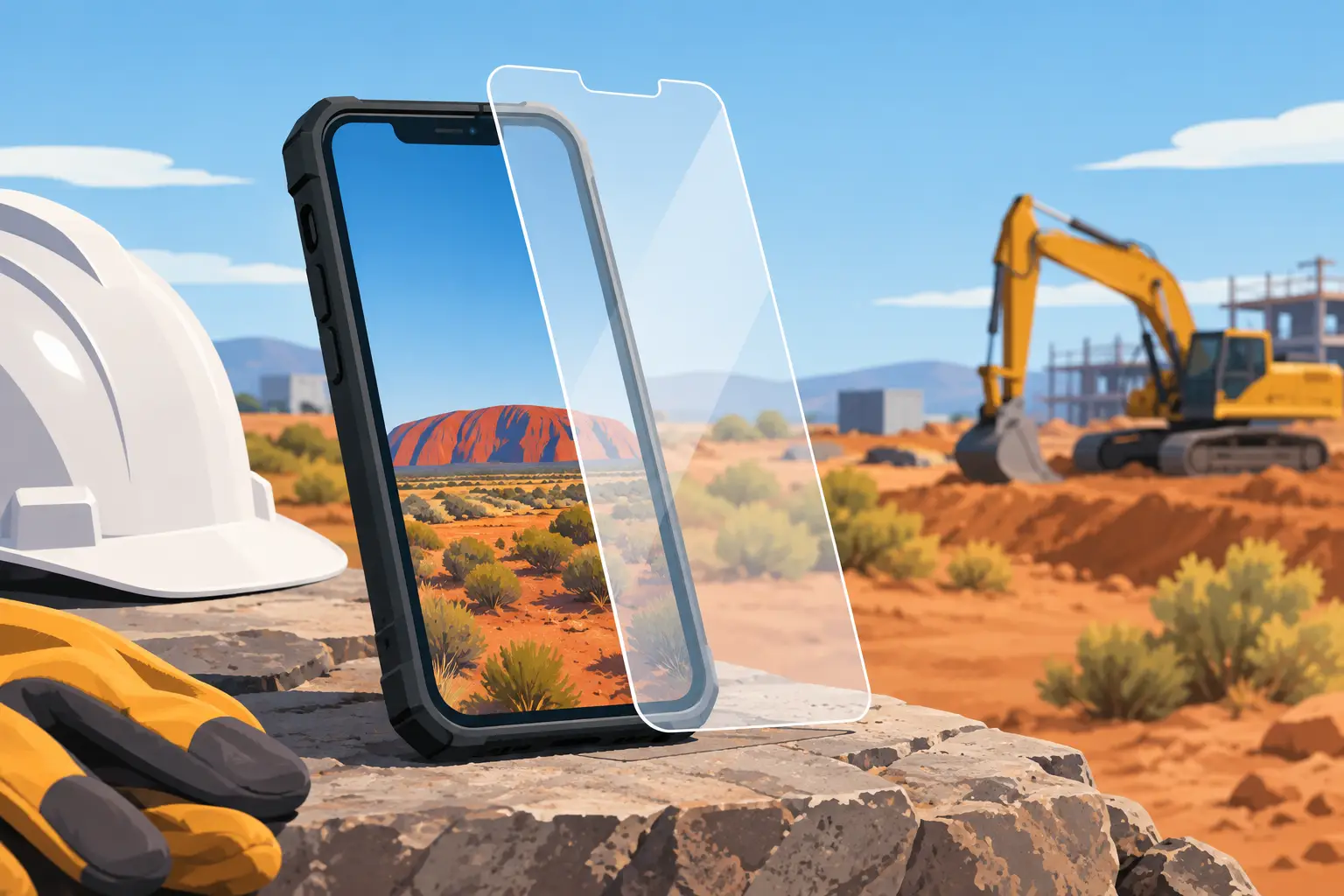
A cracked screen rarely happens in the office. It happens when a mobile slips from a ute tray, catches the edge of a steel bench, or lands face-down in crushed rock. The best screen protectors for worksites are not the ones with the flashiest packaging. They are the ones that suit the phone, the job and the way the device is actually used.
For workers in construction, mining, farming, transport and field service, a protector is not a substitute for a rugged phone. It is an extra sacrificial layer that can save the display from scratches, chips and expensive downtime. Choose the wrong type, however, and you can end up with poor touch response, lifting edges and a protector that peels off before the job is done.
What Makes a Screen Protector Work on Site?
A worksite screen protector has a harder job than one fitted to a consumer phone that spends most of its life in a pocket. It needs to cope with airborne dust, wet hands, work gloves, vibration, sweat, chemical residue and repeated cleaning. It also needs to stay put when the phone is knocked, dropped or exposed to heat in a vehicle cab.
The first rule is simple: fit a protector designed for the exact mobile model. A close-enough option is often false economy. Camera cut-outs may not line up, sensors can be obstructed, and the edges may interfere with the case or rugged bumper. On a phone with a raised screen bezel, a badly sized protector can sit awkwardly below the edge and collect grit around its perimeter.
The second rule is to treat scratch resistance and impact resistance as different things. A hard surface can resist keys, sand and fine grit very well, but a sharp impact can still crack it. That is not necessarily a failure. If the protector breaks instead of the display underneath, it has done useful work.
Tempered Glass: Best for Scratches and Daily Abuse
For most rugged mobiles used on active sites, tempered glass is the best starting point. It provides a smooth feel, strong scratch resistance and a familiar touchscreen experience. It is particularly worthwhile for workers who regularly wipe dust from their screen, use mapping apps outdoors or type reports and messages throughout the day.
A good tempered glass protector should be properly cut for the screen, use full adhesive where possible, and leave enough clearance around the edges for the phone’s case or protective frame. Cheap glass protectors often have adhesive only around the border. They can trap dust, create a rainbow effect under the glass and feel less reliable after a few weeks of hard use.
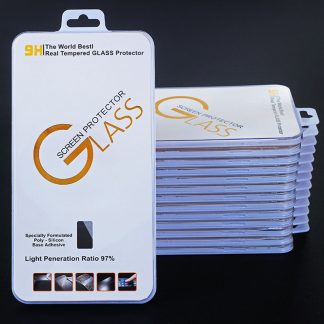
Look for a protector marketed as 9H surface hardness, but do not take that figure as a promise that it cannot break. It refers mainly to resistance against surface scratching under a particular test, not immunity from a drop onto concrete. Thickness also matters. A protector around 0.3 mm usually offers a practical balance between protection, clarity and touch sensitivity. Thicker is not automatically better if it compromises fingerprint recognition or stops the screen responding properly through gloves.
Tempered glass has one obvious trade-off: it can crack. On a rough site, that may happen sooner than you would like. The sensible approach is to keep a spare in the vehicle, site office or tool bag. Replacing a screen protector is a minor job. Replacing a damaged display can take the phone out of service when you need it most.
TPU and Hydrogel Film: Better for Curved or Awkward Screens
Not every rugged mobile is best served by glass. Some screens have curved edges, unusual dimensions or raised sections that make glass hard to fit without edge lift. In those cases, a TPU or hydrogel-style film can be the more practical option.
These flexible protectors absorb light knocks well and are less likely to shatter. They can also cover more of a curved screen than a rigid glass panel. Some minor marks may fade over time, which is useful if the phone is constantly exposed to dust and abrasion.
The downside is that film does not feel as slick or hard as quality tempered glass. It can pick up deeper scratches more readily, and fitting it takes more patience. A poor installation can leave bubbles, dust specks or misaligned edges that quickly become lifting points. For a phone used with dirty hands or gloves, the softer surface can also feel less precise.
Use TPU or hydrogel when fitment is the priority. Choose tempered glass when you want the strongest everyday barrier against grit, rubbing and routine screen damage.
The Best Screen Protectors for Worksites Need Case Clearance
Many screen protector failures are actually case-fitment failures. Rugged phones commonly have thick protective frames, reinforced corners and raised lips around the display. That built-in structure is valuable during a drop, but it means a full-edge protector can be pushed up by the case if tolerances are too tight.
Before fitting anything, check whether the protector is case-friendly. It should stop slightly short of the outermost edge of the display rather than trying to cover every millimetre. This small gap is deliberate. It prevents the case from catching the glass when the phone flexes or takes a hit.
Be wary of universal cut-to-size films for a primary work mobile. They can be acceptable as temporary scratch protection, but they rarely provide clean coverage around the front camera, earpiece and proximity sensor. A rugged device is a work tool, not a place to compromise on fit just to save a few dollars.
Features That Matter More Than Marketing
Anti-glare finishes can be helpful for outdoor work, especially for drivers, surveyors, farmers and crews moving between shade and full sun. They reduce reflections, but usually soften the display slightly and can make high-resolution screens look less sharp. If your work involves reading plans, photos or fine detail, clear glass may be the better choice.
Oleophobic coating matters more than many buyers realise. It helps the screen shed fingerprints, skin oils and grime, making the device easier to clean. The coating will wear over time, particularly when the phone is wiped frequently, but a quality protector remains easier to live with than bare glass covered in smears.
Privacy protectors are generally a poor fit for worksites. They darken the screen from side angles and can make outdoor visibility worse. Unless you are handling sensitive information in public areas every day, clear visibility is usually more useful than a narrow viewing angle.
For phones with in-display fingerprint sensors, check compatibility before buying. Some thick protectors reduce accuracy, particularly when fingers are dusty, wet or worn from manual work. If biometric access is unreliable, register the fingerprint again after fitting the protector and keep a dependable PIN as backup.
Fit It Properly or Do Not Bother
The cleanest installation is done indoors, away from wind and dust. Clean the screen thoroughly, remove every trace of lint, and take your time aligning the protector before lowering it into place. On a site, even one tiny grain of sand under the adhesive can create a bubble or pressure point.
Do not fit a new protector straight after the phone has been sitting in a hot cab or exposed to direct sun. Let the device cool down first. Adhesive behaves better on a clean, dry screen at a moderate temperature. Once fitted, press out remaining air slowly from the centre toward the edges rather than forcing it around with a dirty glove.
If an edge starts lifting repeatedly, replace the protector. Adding tape, glue or improvised fixes usually traps more dust and makes the screen harder to use. A protector is consumable equipment. Treat it that way.
Protection Is a System, Not a Single Purchase
A screen protector works best alongside a proper rugged mobile, a fitted case where appropriate and sensible handling. Raised bezels protect the screen face during flat drops. Reinforced corners help manage impact energy. A wrist strap, belt holster or secure mounting solution can prevent the drop altogether.
Rugged Phones Australia takes the same approach when assessing hard-use devices: the real question is not whether a specification looks impressive on paper, but whether the gear remains dependable after months of work. A cheap protector that lifts in a fortnight is not protection. It is rubbish waiting to happen.
Choose the protector that matches your exact phone and your actual environment, then keep a spare ready. On a hard site, the best result is not a screen protector that looks untouched. It is one that takes the punishment so your mobile can keep working.