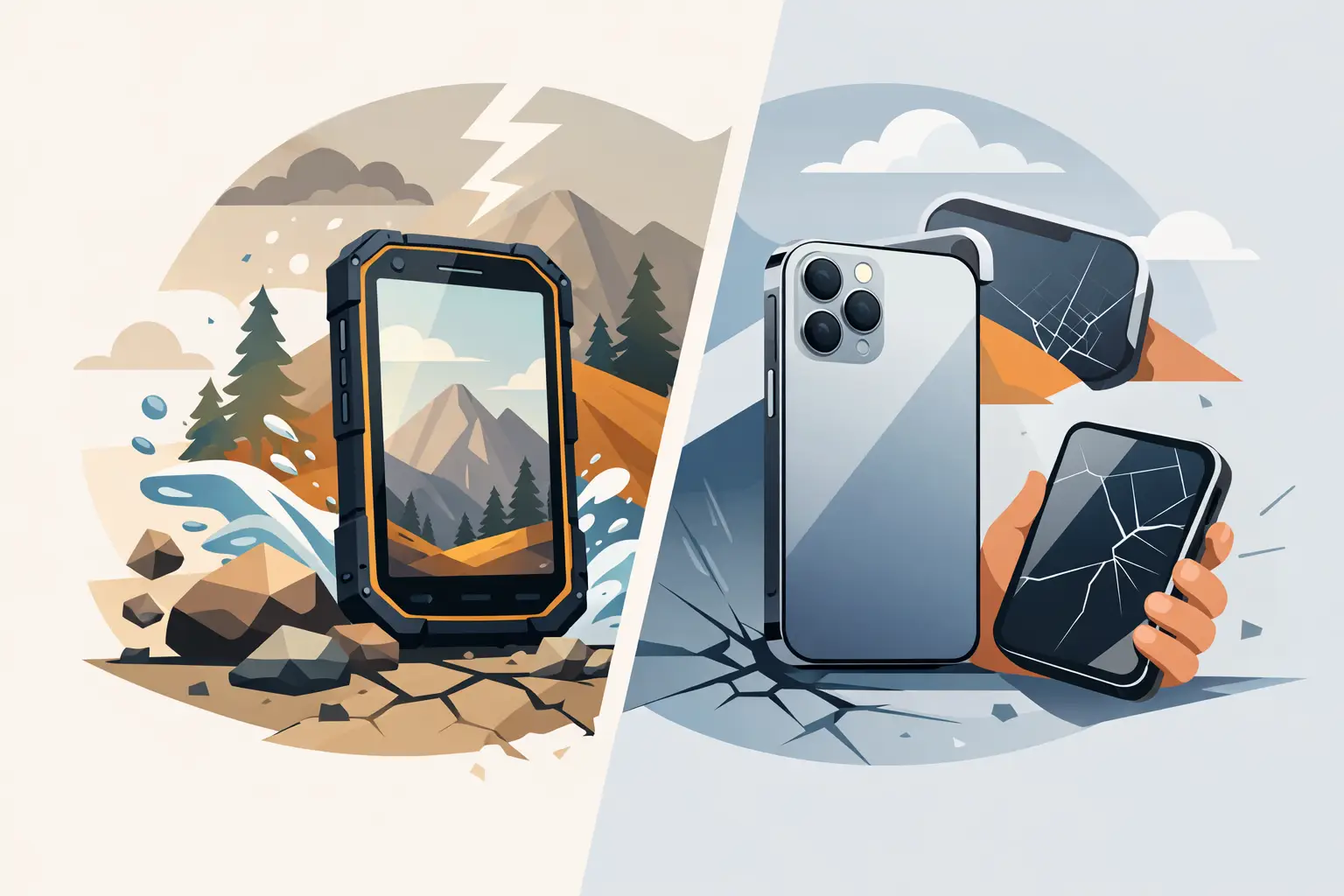
A cracked screen at the start of a mine shift, a flat battery halfway through a fencing job, or a mobile dropped into mud beside the ute changes the rugged smartphone vs iPhone question quickly. This is not about which logo looks better at the pub. It is about whether your phone can keep working when weather, dust, vibration and hard knocks are part of the job.
An iPhone is an excellent consumer smartphone. It has polished software, strong cameras and a familiar ecosystem. But it is designed first for everyday life, not for being mounted in a loader, carried through a wet paddock or used with filthy gloves on. A properly selected rugged smartphone is built around a different priority: staying useful when conditions are trying to wreck it.
Rugged smartphone vs iPhone: start with the job
The right choice depends on what your mobile has to survive and what it has to do. If you work mostly indoors, protect your phone with a good case, have easy access to power and rely heavily on Apple-only services, an iPhone can be the sensible option. There is no prize for carrying a heavier phone than you need.
If your work involves construction sites, transport, agriculture, mining, emergency response, outdoor maintenance or remote travel, the calculation shifts. Downtime costs money. A phone that needs a screen replacement after one drop, or cannot last a full day away from a charger, is not a work tool. It is another point of failure.
A rugged mobile will usually be thicker and heavier than an iPhone. That is not poor design. It is the physical cost of reinforced corners, raised screen protection, larger batteries, sealed ports and a housing made to absorb impact. For a worker wearing a tool belt, that trade-off is often worthwhile.
Durability is more than a tough-looking case
A case can greatly improve an iPhone’s chances, and a quality case is better than going bare. But a case does not turn a consumer handset into a purpose-built industrial device. The ports, buttons, camera area and internal construction still matter. So does what happens after repeated vibration, heat, drops and exposure to grit.
Most current iPhones carry an IP68 water and dust resistance rating. That is useful protection against accidental spills and brief water exposure within the manufacturer’s test conditions. It should not be treated as permission to pressure-wash the phone, leave it in a wet tool bag, or assume a damaged seal will keep water out.
Many rugged phones are rated IP68 and IP69K, with additional drop and environmental testing commonly referenced through MIL-STD-810H. IP69K is particularly relevant where high-pressure, high-temperature water jets are a realistic risk, such as wash-down areas, farming equipment and industrial settings. The rating itself is not a magic shield, though. Read the exact specifications, use the port covers properly and do not confuse marketing claims with tested protection.
The better rugged models also make practical choices an ordinary phone often avoids: pronounced side buttons that work with gloves, textured housings that are less likely to slip, reinforced charging ports and screens recessed beneath the bezel. Those details matter more than a glossy back panel when rain is coming sideways and you need to answer a call.
Repairability and support matter after the drop
No phone is indestructible. Screens can break, charging ports can wear and batteries eventually lose capacity. The difference is whether there is a realistic path to repair and warranty support.
This is where buyers should be cautious with cheap imported rugged phones. A huge battery and a dramatic IP rating mean little if the device has poor-quality components, no local support, questionable Australian network compatibility or no practical repair option. A phone that is glued shut and unsupported is disposable, regardless of how tough its advertising looks.
At Rugged Phones Australia, the focus is on models worth supporting, rather than filling a catalogue with every low-cost device available. For hard-use buyers, warranty protection and access to advice are part of the product, not an optional extra.
Battery life: the advantage is usually clear
iPhones are efficient, and their battery performance has improved substantially. For normal calls, messages, navigation and photos, many users will get through a day. Heavy use changes that picture. Weak reception, hotspot use, long navigation sessions, video calls and cold weather all add pressure.
Rugged smartphones frequently use much larger batteries, commonly well beyond the capacity of a standard flagship phone. That can mean two or three days of practical use for workers who cannot depend on a wall socket every night. Some models also support charging docks, replaceable accessories or reverse charging for a radio, light or another mobile.
There is a trade-off. Bigger batteries add weight, and charging them can take longer if the phone does not support sufficient fast charging. Check the supplied charger, charging standard and connector protection before buying. For remote work, it also makes sense to carry a 12V charger or a quality power bank, regardless of which phone you choose.
Cameras and specialist tools
For ordinary photography and social media video, an iPhone is hard to fault. Its image processing is polished, low-light performance is strong, and the camera experience is quick. If content creation is a major part of your work or personal life, that is a genuine advantage.
A rugged phone takes a more practical approach. Its standard camera may be perfectly capable for documenting a damaged asset, recording a delivery, photographing a serial number or sending site images. More importantly for certain trades, some models offer tools an iPhone does not: thermal imaging, night vision, programmable buttons, powerful torches, laser range finding or extra-loud speakers.
Thermal imaging is not a gimmick when you are checking electrical hotspots, heat loss, machinery bearings, livestock or irrigation issues. Night vision can be useful for security, camping, inspections and after-dark work. These features are not needed by everyone, but when they fit the job, a separate device may no longer be necessary.
Software, apps and network compatibility
This is the area where an iPhone often wins for people deeply invested in Apple services. iMessage, FaceTime, AirDrop, Apple Watch integration and long-term operating system updates are compelling. If your family, office and workflow run through Apple, changing platforms has a cost.
Rugged smartphones generally run Android, so they suit workers who need access to Android business apps, Google services, device management tools and flexible hardware options. The interface will vary by manufacturer, and buyers should not expect every rugged handset to feel identical to a premium iPhone. The important question is whether it runs the apps your team actually uses.
For Australian buyers, network bands are not a minor specification. Check 4G and 5G compatibility with your carrier, especially if you work outside metropolitan areas. Telstra, Optus and Vodafone use different frequencies, and regional coverage depends on more than the phone itself. A mobile with the wrong band support can look impressive on paper and still perform poorly where you need it most.
Do not buy features you will never use
A thermal camera, 20,000mAh battery and night-vision sensor sound impressive, but they are not automatically the best choice. A transport driver may value battery life, loud audio and a secure mount more than thermal imaging. A farm manager may need dual SIM support and a reliable camera. A site supervisor may care most about a bright screen, glove-friendly operation and a phone that survives constant drops.
Likewise, not every person needs a full smartphone. For schools, vulnerable users or workplaces where distraction is a problem, a durable feature phone with calls and texts can be the safer, simpler answer. Buying the most expensive device is not the same as buying the right one.
Which mobile gives better value?
An iPhone can be cheaper to carry if it stays protected, fits your workflow and lasts for years without damage. Add a premium case, screen protector and insurance, however, and compare the total cost honestly. One serious screen break, water incident or battery failure can erase the apparent saving.
A rugged smartphone often costs more upfront than a basic Android phone, but it earns its keep through fewer interruptions, longer battery life and capabilities that remove the need for separate gear. The value is strongest when the phone is exposed to genuine risk every week, not just the occasional camping trip.
Before choosing, be blunt about your workday. Where is the phone carried? Will it be used in rain, dust or gloves? Is charging available? Do you need thermal imaging, 5G, dual SIM or a physical programmable button? And if it fails, who will help you sort it out?
Choose the phone that suits the conditions you actually work in, not the one that looks toughest in an advert. When your mobile is essential gear, reliability is not a luxury feature. It is the whole point.