A cracked screen at smoko is annoying. A dead mobile halfway through a remote job, a wet harvest, or a night shift can cost far more than the phone itself. This rugged phone buying guide is for people who need a device that keeps working when dust, rain, vibration, drops and long days are part of the job – not occasional inconveniences.
The wrong rugged phone is often just a heavy budget handset in a thick case. It may carry an impressive-looking spec sheet, yet have poor network support, weak internal components, no realistic local warranty path, or a battery that fades when it is needed most. Buy for the conditions you actually work in, then check the details that prove a phone is built to handle them.
Start with the job, not the spec sheet
There is no single best rugged mobile for every worker. A fitter climbing around plant equipment, a farm manager spending days away from power, and a supervisor who needs thermal imaging have different priorities. The sensible purchase starts with the failure points of your current phone.
If screens keep breaking, focus on display protection, a raised bezel and available screen-replacement cover. If your phone dies before knock-off, battery capacity and charging speed matter more than a high-resolution camera. If you work around water, mud or fine dust, proper sealing and port protection should be non-negotiable. For drivers and field teams, reliable 4G or 5G bands and GPS performance can matter more than having the largest battery on the market.
A rugged phone should solve a real operational problem. Do not pay extra for thermal imaging, night vision or a massive battery simply because it sounds tough. Those features are valuable when the job calls for them. Otherwise, they add size, weight and cost without improving your day.
Rugged phone buying guide: ratings that actually matter
Most buyers see IP ratings and MIL-STD claims, then assume every rugged device offers the same protection. It does not. Ratings are a starting point, not a blank cheque to abuse a phone.
Understand IP68 and IP69K
An IP68 rating generally indicates strong resistance to dust and immersion in water under stated test conditions. IP69K adds resistance to high-pressure, high-temperature water jets. That can be useful for dirty industrial environments, workshops and agricultural work where equipment is regularly washed down.
Read the fine print where it is available. Water resistance is tested in controlled conditions, not after months of impacts, worn seals and grit lodged around the charging port. Rinse saltwater, chemicals and mud off the phone promptly, dry it before charging, and check that port covers sit properly. Even the toughest device benefits from basic care.
Treat MIL-STD-810H as supporting evidence
MIL-STD-810H is a testing framework covering conditions such as shock, vibration, temperature and humidity. It is worth having, but it is not a universal score. Manufacturers can test different methods, heights and conditions. A claim without clear construction quality, credible warranty support and sensible design should not decide the purchase.
Look at the physical details too: reinforced corners, a frame that protects the display edges, secure buttons, properly seated covers and a housing that does not flex excessively. A phone can pass a lab test and still be a poor work tool if it feels cheaply assembled or is difficult to service after damage.
Battery capacity is only half the story
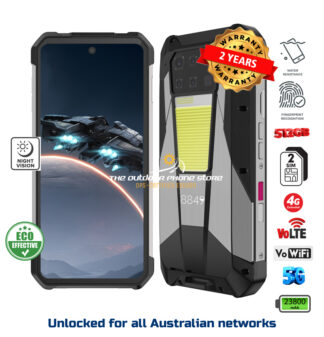
Big batteries are one of the main reasons workers move to rugged mobiles. A 10,000mAh to 20,000mAh battery can make a genuine difference for remote work, long shifts and camping away from mains power. But capacity alone does not tell you how useful the phone will be.
A large display, power-hungry processor, bright torch, 5G use and frequent GPS tracking all draw heavily on the battery. Thermal cameras and night-vision sensors do too. Check how you use the phone rather than relying on standby figures. Navigation, photos, work apps, hotspot use and two-way communication are more demanding than reading messages.
Charging is the trade-off. A huge battery can take a long time to refill unless the handset supports suitably fast wired charging. Wireless charging may be convenient in a vehicle or office, but a protected USB-C port is often more practical in the field. If downtime is expensive, choose a model that balances capacity with charging speed and carry a quality power bank or vehicle charger as backup.
Network compatibility is not optional in Australia
A phone that survives a drop is no help if it cannot hold a usable signal. Australian network compatibility deserves more attention than it gets, particularly after the 3G shutdown and for anyone operating outside metropolitan areas.
Check that the device supports the Australian 4G and 5G bands needed by your chosen carrier, along with VoLTE compatibility for calls over 4G. Do not assume an imported model will work properly just because it shows a few bars of signal. Some cheap grey imports lack essential bands, have incomplete carrier support, or cannot make reliable emergency and voice calls after network changes.
For remote work, assess your carrier coverage where you actually travel – on the property, along transport routes, around mine sites and in regional townships. Telstra-based coverage is often a practical consideration for rural users, but the right service depends on the area. Dual SIM can be worthwhile when work and personal services need to stay separate, or when a second network provides a useful fallback.
Choose a screen you can use with dirty hands
A giant display is excellent for maps, drawings, job sheets and camera work. It also makes the phone larger, heavier and easier to catch on a pocket or tool belt. Smaller rugged phones are easier to carry, while larger models suit workers who use the screen all day.
Brightness matters more than showroom colour. A display that cannot be read in harsh Australian sun is a frustration from day one. Look for good outdoor visibility, responsive touch operation and, if relevant, glove or wet-touch support. A physical programmable button is also worth having. It can launch a torch, push-to-talk app, camera, SOS function or barcode scanner without digging through menus.
Screen protection should be considered a system, not a marketing label. Toughened glass, a raised lip around the display and a well-fitted screen protector work together. A replaceable protector is cheap insurance, but it does not replace a solid warranty or a device designed to absorb impact around the corners.
Buy cameras and specialist tools for the work
For many field workers, the camera is no longer a lifestyle feature. It records defects, quotes, site progress, deliveries, compliance issues and damage before a repair begins. Prioritise reliable autofocus, usable low-light performance and clear detail over inflated megapixel claims.
Night vision can be useful for property checks, wildlife monitoring, security rounds and low-light inspections. Thermal imaging is more specialised and more valuable when it earns its keep. Electricians, maintenance teams and building inspectors may use thermal tools to identify heat anomalies in switchboards, motors, bearings and insulation. It is not a substitute for trained diagnosis, but it can help find where to investigate.
Other useful work features include a powerful torch, loud speaker, NFC for access or payments, a lanyard point and an expandable storage option for photos and offline maps. Decide which of these will be used weekly. The rest should not distract from core reliability.
Do not ignore weight, repairs and warranty
Rugged phones are heavier than mainstream mobiles. That is the cost of a reinforced chassis, larger battery and added sealing. Before buying, be honest about where it will live: trouser pocket, breast pocket, belt holster, ute console or tool bag. A 600-gram handset may be brilliant for a remote field kit and annoying for someone climbing ladders all day.
Support matters once the sale is over. Ask who handles warranty claims, whether accidental damage or screen cover is available, and whether the supplier can identify the exact model and component variant being sold. The cheapest online listing is rarely cheap when it arrives with unsuitable firmware, poor bands, no parts path and nobody local willing to help.
This is why curated stock matters. Rugged Phones Australia focuses on models that are worth putting into hard service, rather than flooding the catalogue with every low-cost factory variation available. A properly sourced device with clear support is a better investment than a questionable bargain that fails at the first difficult moment.
Make the final call on practical value
Before you order, picture a normal working week. Will the phone last through your shift? Can you read it in full sun? Does it work properly on your network? Will it survive the dust, rain, vibration and drops you actually encounter? Can you get help if the screen is damaged or something goes wrong?
If the answer is yes, you have found a work tool rather than a novelty brick. Choose the phone that removes the most risk from your day, protect it sensibly, and it will earn its place long after a standard consumer mobile has become expensive rubbish.