A phone that dies after one drop off a scaffold is not a work tool. It is a liability. If you are trying to find the best rugged phone for construction, forget flashy marketing and start with what actually matters on site – durability, battery life, screen usability, loud audio, network performance and whether the device will still be dependable six months from now.
Construction is harder on phones than most brands care to admit. Dust gets into ports, concrete powder gets everywhere, rain hits when the forecast got it wrong, and a mobile ends up on the dash, in a pocket full of screws, or on the floor of the ute. A standard consumer phone in a fancy case can survive some of that. It usually will not survive all of it.
What makes the best rugged phone for construction?
The short answer is this: the best phone is not the one with the biggest spec sheet. It is the one that holds up under repeated punishment while still doing the basics properly. That means stable calls, decent reception, battery that lasts a full shift and then some, and a screen you can actually read outdoors.
A proper construction phone should have strong ingress protection, solid drop resistance and a frame that is built for impact rather than cosmetics. IP68 and IP69K ratings matter, but they are not the whole story. Two phones can share the same rating and still perform very differently in the real world. Build quality, sealing quality and factory standards matter just as much. This is where a lot of cheap marketplace imports fall apart. On paper, they look similar. In hand and over time, they are not.
MIL-STD claims can be useful as a rough guide, but they are often oversold. A rugged phone still has limits. Drop one onto rebar at the wrong angle and you can still break it. The smarter way to buy is to look for a phone that is engineered to survive regular site abuse, not one that pretends to be indestructible.
Choose by job, not by hype
Construction workers do not all need the same phone. A site supervisor has different needs from a concreter, an electrician or someone working civil projects in remote areas. If you spend most of the day taking photos, sending updates and running project apps, screen quality, camera performance and 5G matter more. If you are on tools all day and just need calls, messages, maps and battery life, a simpler and tougher model can be the better buy.
This is where people often overspend in the wrong direction. They chase thermal cameras, huge memory figures or novelty extras they will never use, while ignoring practical things like speaker volume and charging reliability. On a noisy site, a weak speaker is a pain. In a long shift, poor battery management is worse than a slightly slower processor.
Durability is more than a thick shell
A rugged phone should feel planted in the hand, not like a toy wearing armour. Good rugged mobiles use reinforced corners, stronger frames and screen protection that can cope with repeated knocks. Some also avoid design shortcuts that make repairs harder or long-term reliability worse.
That last part gets overlooked. Plenty of low-grade rugged phones are built to look tough for the first few weeks. After that, problems show up – failing ports, swollen batteries, touch issues, charging faults or poor waterproof sealing. A construction phone has to be dependable, not just bulky.
There is also a trade-off here. The toughest phones are usually thicker and heavier than a standard smartphone. That is the price of proper protection and large batteries. For most tradies, that trade-off is worth it. If you hate carrying a substantial handset, you may be better off accepting less protection rather than buying a rugged model and resenting it every day.
Battery life matters more than most specs
On construction sites, battery is not a luxury feature. It is part of whether the phone is usable. If your mobile is handling calls, job management apps, GPS, hotspot duties, photos and torch use, a weak battery gets exposed fast.
The better rugged phones usually carry much larger batteries than mainstream handsets. That gives you longer runtime, but there is more to it than capacity. Software efficiency, charging stability and screen power use all affect how well the phone lasts in practice. A massive battery with poor optimisation can still disappoint.
For many buyers, a genuinely reliable two-day battery is more useful than a flagship-grade camera. If you work long shifts, travel between jobs or spend time in remote areas where charging is not always easy, battery should be near the top of your list.
Screens, gloves and outdoor visibility
Construction work happens in bright sun, dust and wet conditions. A phone with a dim display or poor touch response becomes frustrating very quickly. You want a screen with enough brightness to stay readable outdoors and touch settings that still behave when your hands are dirty or gloved.
Some rugged phones offer glove mode or extra touch sensitivity. That can be useful, but it depends on the type of gloves and the work conditions. Do not assume every glove-friendly claim works perfectly across all situations. It is better to treat it as a bonus rather than the main reason to buy.
Screen size is another practical choice. Bigger screens help with plans, forms and photos, but they are harder to pocket and easier to knock around in tight spaces. Mid-to-large screens suit most site managers and foremen. For workers who want a simpler, easier-carry option, a slightly smaller device can make more sense.
Cameras are a work feature now
On site, the camera is no longer just for personal use. It is for documenting defects, recording progress, sharing delivery issues, scanning documents and proving what happened when there is a dispute. That means the best rugged phone for construction should have a camera system that is reliable and quick, not just impressive on a spec card.
You do not need studio-quality photos. You do need sharp images in mixed lighting, decent close-up focus and fast shutter response. If the camera struggles to capture a clear shot of a crack, label or installation detail, it is not doing its job.
Thermal imaging can be valuable for specific trades and inspections, but it is not essential for most construction buyers. The same goes for night vision. These features are useful in the right role and wasted money in the wrong one. Buy for your actual work, not for bragging rights.
4G, 5G and network support in Australia
Network compatibility is where a lot of people get caught. A phone can be rugged and still be a poor choice if it does not support the right Australian bands properly. Construction workers often move between metro sites, fringe coverage areas and regional jobs, so reception matters.
If you rely on your phone for calls, maps and job updates, proper network support is not optional. 5G is worth having if you use data heavily or plan to keep the phone for a few years, but a good 4G device can still be the smarter buy if the coverage where you work is patchy or the phone is otherwise stronger on the basics.
What matters most is not the badge on the box. It is whether the device is properly suited to Australian networks and backed by local support if something goes wrong.
The brands worth looking at
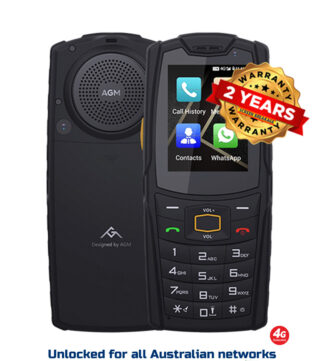
In rugged phones, the brand matters less than the model and the source. Ulefone, AGM, Oukitel, Blackview and Unihertz all produce devices that can suit hard-use buyers, but not every model from every factory run is worth your money. That is why careful curation matters.
Some phones are built for all-round construction use with big batteries, loud speakers and modern Android performance. Others suit niche roles such as compact carry, thermal work or limited-use communications. The mistake is buying by brand alone, or worse, buying the cheapest listing from a random seller and assuming it is the same device.
A specialist retailer like Rugged Phones Australia earns its keep here by filtering out the rubbish, checking sourcing quality and backing the sale with local support. For a construction buyer, that matters more than saving a small amount upfront on a phone that turns into a warranty headache.
How to narrow it down fast
If you want the best rugged phone for construction, ask four blunt questions. First, do you need full smartphone capability with apps and 5G, or mainly calls, messages and maps? Second, how important is multi-day battery life? Third, are you taking site photos every day? Fourth, are you working mostly metro, regional or remote?
Those answers usually make the choice much clearer. A foreman running admin and photos all day should lean towards a well-balanced rugged smartphone with a bright screen, good camera and solid 5G support. A tradesman who mostly wants something hard to kill may be better served by a simpler, chunkier model with exceptional battery life and fewer moving parts.
The best buying decision is usually the one that cuts out features you will not use and puts the budget into reliability. That is how you end up with a phone that earns its place on site instead of becoming another cracked-screen lesson.
Buy the mobile that fits the job, survives the abuse and keeps working when the easy options have already packed it in.